Overview
Players secretly place flowers or skulls, then bid on how many flowers they can safely reveal. The highest bidder must attempt the challenge.
Edition scope. Base rules, with the newer Last Chance variant noted below. Decide whether to use it before starting; do not introduce it midgame.
Objective
Win two challenges, or be the only player who has not been eliminated.
Setup
- Give each player a matching set of 3 Flowers, 1 Skull, and a mat with the unscored side up.
- Choose a first player. At the start of each round everyone places 1 disc face down; the first player chooses theirs last.
- Stack discs so their number remains visible. Agree whether to use Last Chance.
How to play
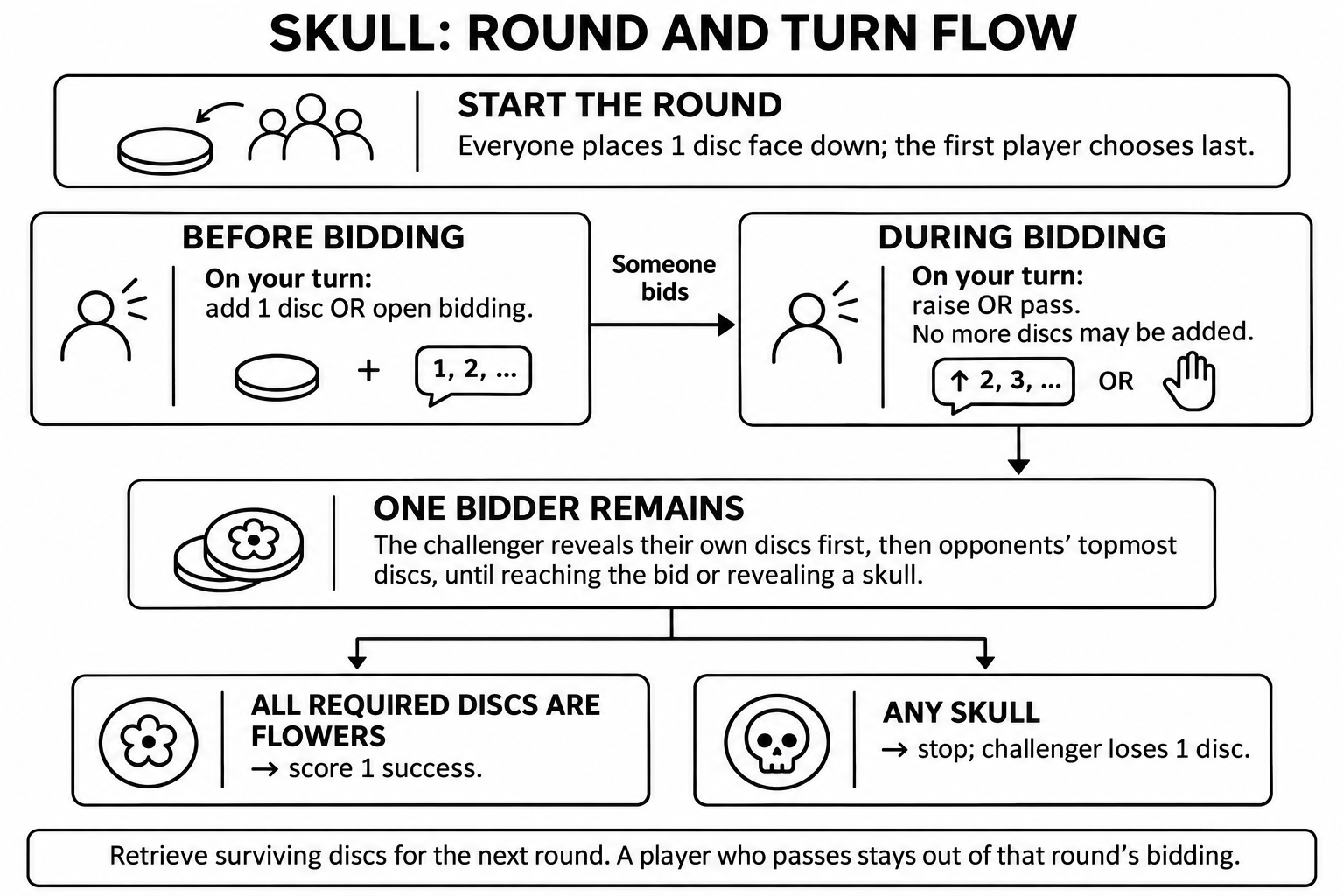
Everyone places 1 disc → add a disc or open bidding → raise / pass → reveal your own first → flowers succeed, a skull fails.
Add or open
On your turn, add 1 disc face down to your own stack OR announce a positive bid up to the total number of discs on the table. If you cannot add a disc, open bidding.
Bid
Once bidding opens, no more discs can be placed. Raise the bid or pass. Passing is final for this bidding round, but your discs remain available to reveal.
Challenge
When only the highest bidder remains, they reveal discs. Reveal your own before anyone else’s. Reveal only the topmost face-down disc in any stack; you may switch between opponents’ stacks.
Resolve
Reveal the number you bid, all flowers: score one success. Reveal a skull: stop immediately and permanently lose one of your own discs.
Newer Last Chance variant
If a failed challenge leaves you with only one disc, take the publicly known Flower Last Chance disc for the next round only, then return it. If you fail as challenger during that round, lose both the temporary disc and your final disc and be eliminated. Each player can receive it only once per game.
Worked example
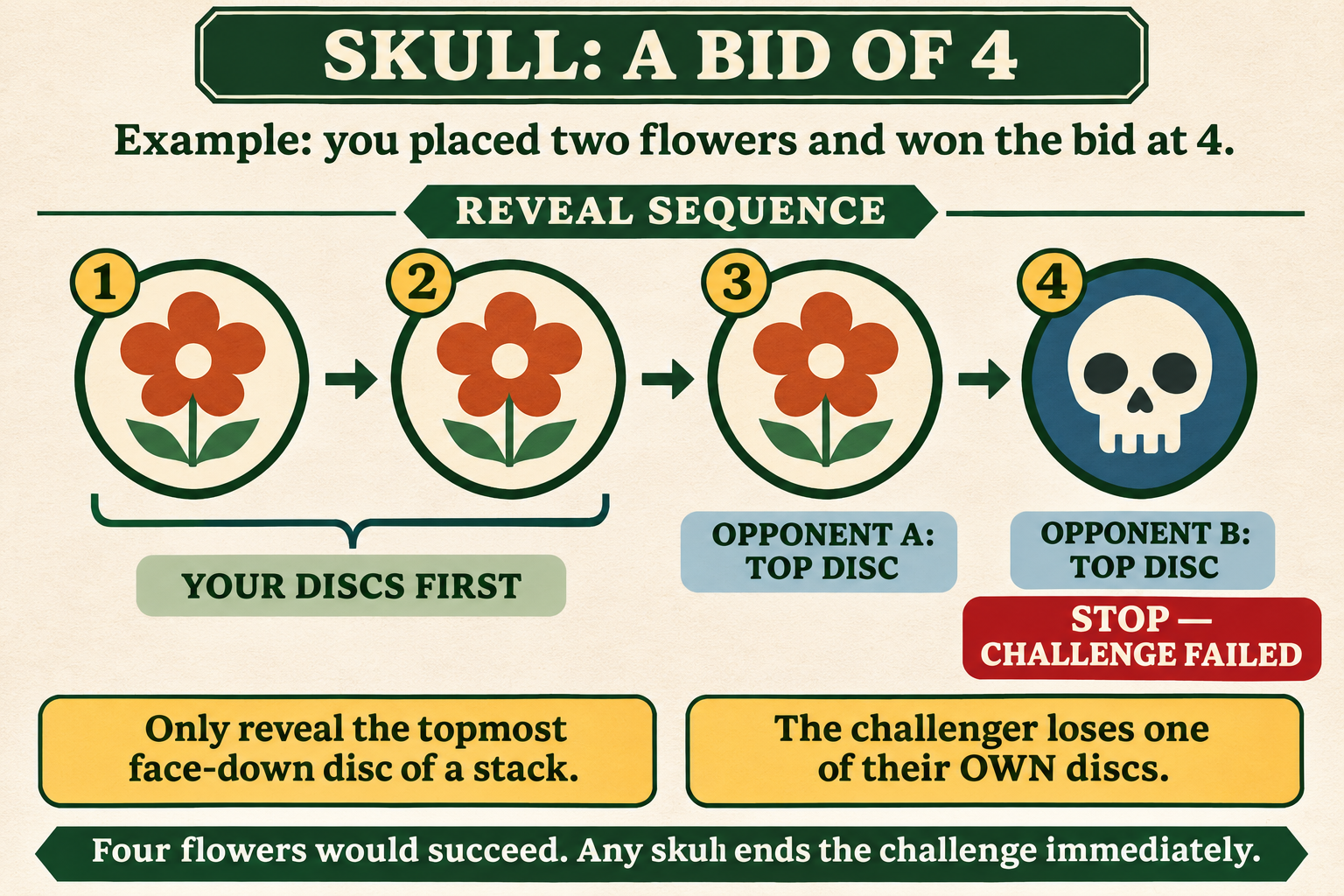
You placed two flowers and won with a bid of 4. Reveal your own two first, then two discs from the tops of other stacks. If the second outside disc is a skull, you fail immediately.
Ending & scoring
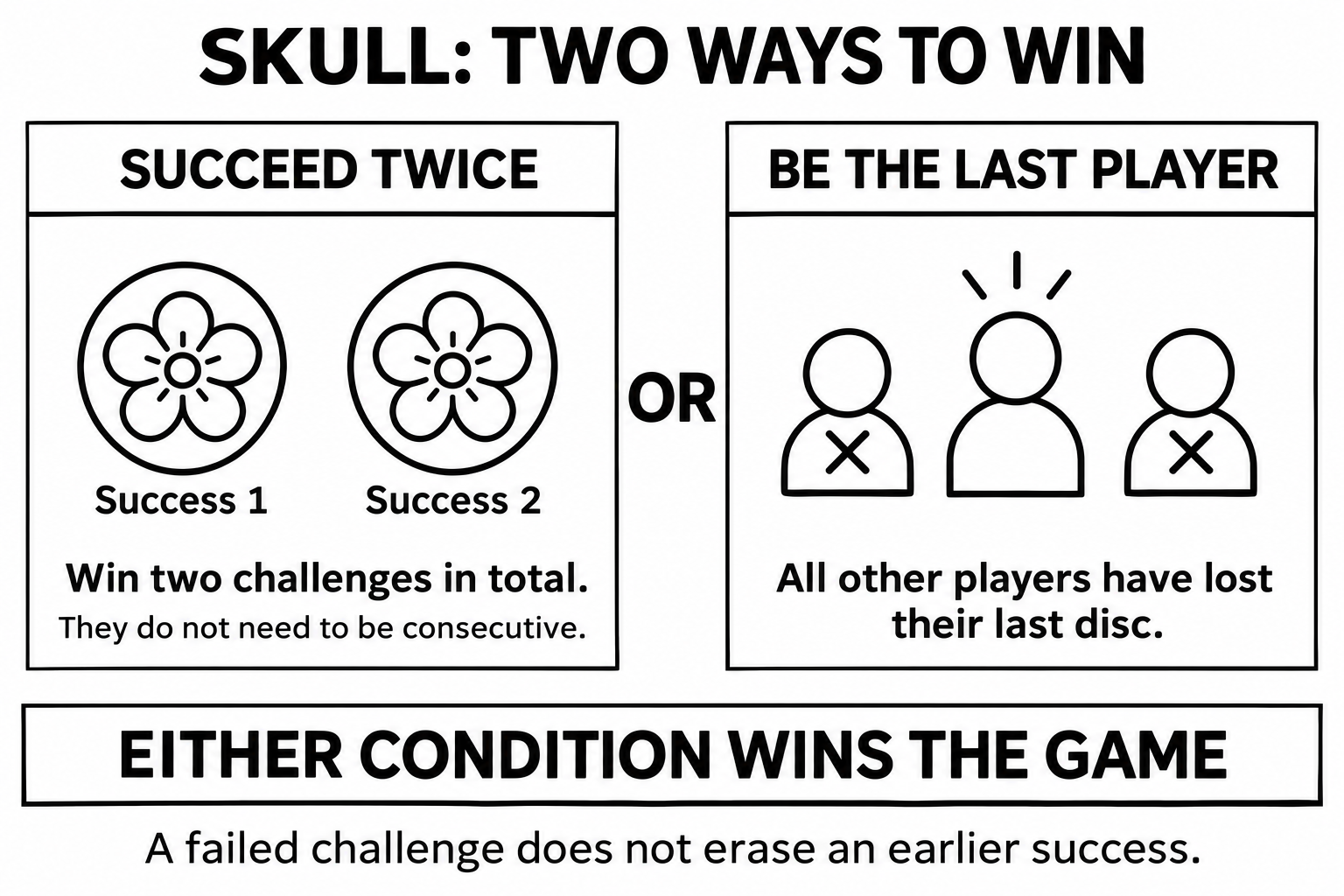
Win by succeeding twice or being the last player remaining. Failure does not erase an earlier success. If you reveal another player’s skull, mix all your remaining discs; that player removes one at random without looking. If you reveal your own skull, secretly choose one of your discs to remove. Lose your last disc and you are eliminated. Everyone retrieves surviving discs between rounds. The challenger starts the next round unless eliminated; then the skull’s owner starts. A self-eliminated challenger chooses the next starter.
Rules to double-check
- Passing withdraws you from bidding; it does not remove your discs from the table.
- You cannot reveal an opponent’s discs before revealing your own.
- Do not reach below a stack’s top disc or continue after revealing a skull.
- The failed challenger loses a disc, not the player whose skull was revealed.
Sources & edition notes
Space Cowboys · Skull rulebook ↗
Rules sources checked on 13 November 2026. Teaching scripts and practice tasks are suggested hosting aids. The publisher’s rules and the edition in the box remain the reference for exceptions.